Taking the first step toward a healthier lifestyle can feel overwhelming. If you are trying to figure out how to start working out or feeling lost amid cookie-cutter routines, you are not alone. Stepping into a gym should feel empowering, not confusing.
Investing in personal training for beginners bridges the gap between wanting results and knowing exactly how to get them safely. This beginner fitness guide breaks down what to expect, how to avoid common pitfalls, and how localized, hands-on coaching sets you up for long-term success.
Why Starting Matters More Than Starting Perfectly
About 31% of adults worldwide do not meet recommended activity levels, while only 22.5% of U.S. adults meet both aerobic and strength-training guidelines.
These numbers do not suggest that people lack goals. They show that turning good intentions into a consistent routine can be difficult.
Work schedules, family responsibilities, uncertainty, gym intimidation, unrealistic plans, and previous disappointments can all get in the way. That is why effective personal training for beginners is not simply about being told which exercise to perform. It is about removing confusion and creating a clear path forward.
The 2026 Fitness Message: Consistency Beats Complexity
The American College of Sports Medicine’s (ACSM) 2026 guidance recommends training major muscle groups at least twice per week and progressing gradually. The best program is not the most complicated one; it is the one you can follow consistently.
This reflects the MK Fitness approach: personalized coaching, functional movement, steady progress, and sustainable results.
Quick Check: What Is Your Starting Point?
Choose the statement that sounds most like you.
A. “It’s been a while since I worked out.”
Your first step should be rebuilding comfort with movement. Walking, bodyweight exercises, mobility work, and introductory resistance training may form the foundation of your program.
B. “I work out occasionally, but I have no structure.”
You may benefit from a weekly schedule, measurable goals, planned progression, and guidance on exercise selection.
C. “I keep starting and stopping.”
Your main challenge may not be exercise knowledge. You may need accountability, a more realistic schedule, and a program that works around your actual lifestyle.
D. “I am active, but I am not seeing progress.”
Your workouts may need clearer progression, better recovery, improved nutrition habits, or more accurate progress tracking.
There is no “bad” starting point. A qualified personal trainer for beginners uses this information to decide what your program should include, not to judge what you have or have not done before.
Step 1: Turn a General Goal Into a Useful Goal
“I want to get fit” is a positive intention, but it is too broad to guide a program. A trainer may help you turn it into something more specific:
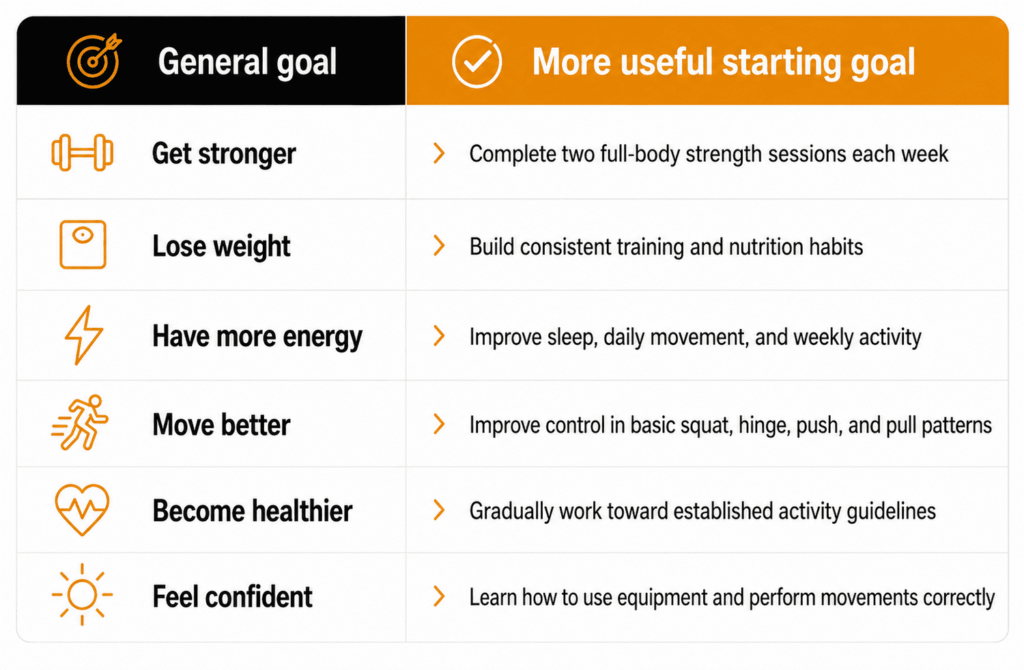
Your goal should also connect to daily life. Perhaps you want to climb stairs without feeling exhausted, carry groceries more comfortably, keep up with your children, improve your posture at work, or feel confident wearing your favorite clothes again.
Those outcomes can make your plan more personally meaningful than a number on the scale.
Step 2: What to Expect During Your First Personal Training Session
Your first session should focus on understanding your starting point, not pushing you to exhaustion.
Your trainer may review:
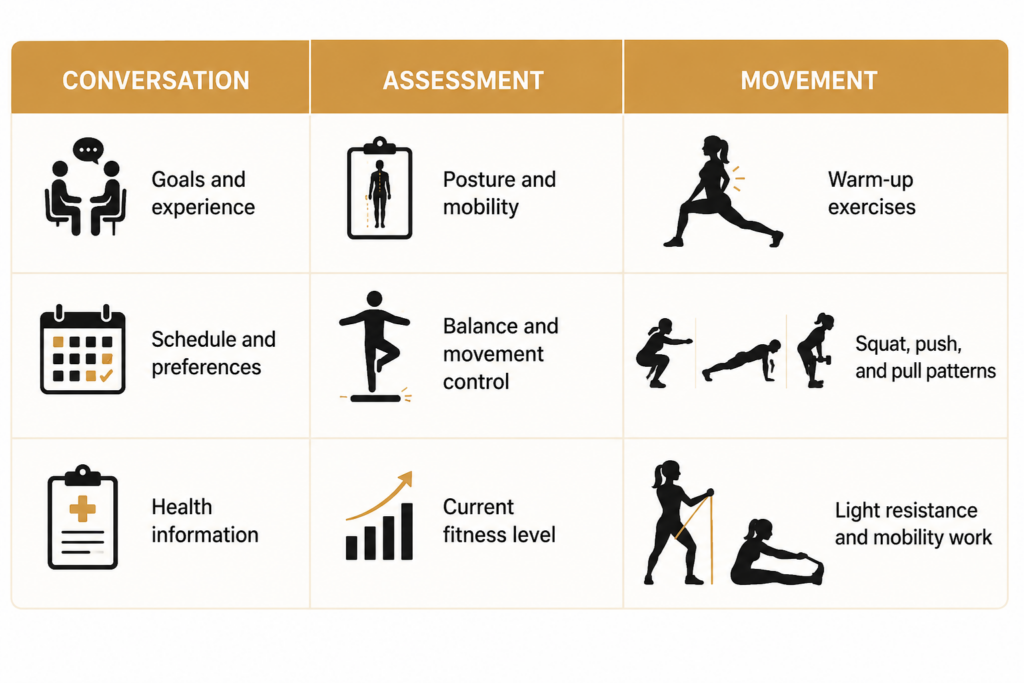
At MK Fitness, this information helps create a personalized plan based on your goals, abilities, and lifestyle.
What to Bring
- Comfortable workout clothes and supportive shoes
- Relevant health or injury information
- Your goals and questions
- Any scheduling concerns
MK Fitness provides the equipment, water, and clean towels.
Beginner reminder: Your assessment is a starting point, not a test.
Step 3: Build a Beginner Workout Plan You Can Repeat
A good beginner workout plan should challenge you without leaving you too exhausted to continue.
Beginners can start with two full-body strength sessions and a few days of light activity, then gradually work toward recommended activity levels.
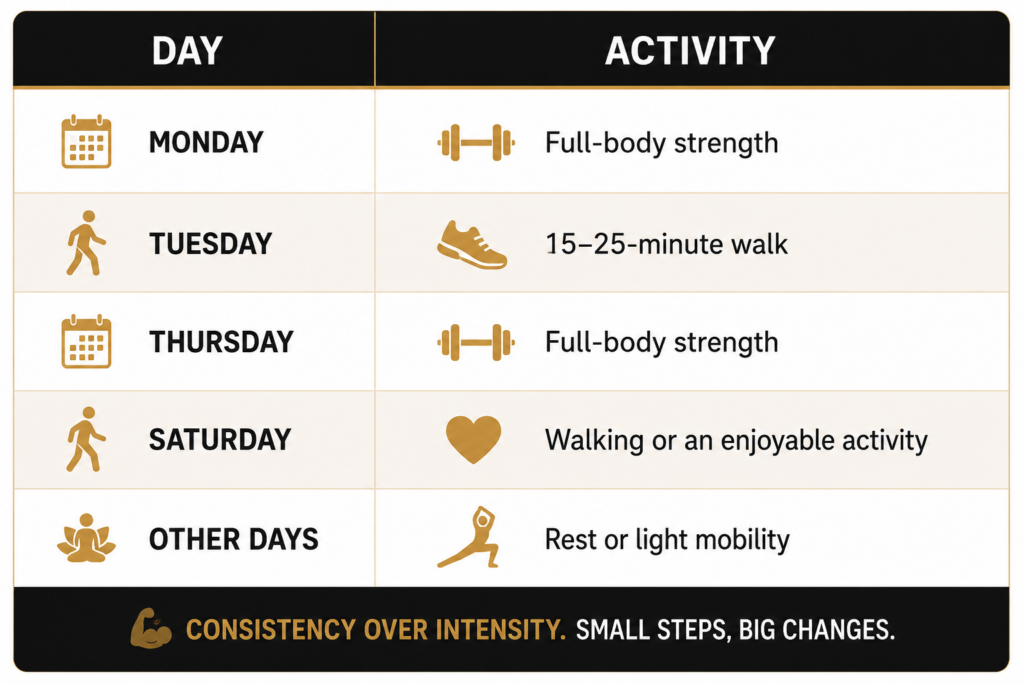
During beginner strength training, focus on controlled movement, breathing, and proper technique. Bodyweight exercises, resistance bands, and simple weights can all be effective.
For moderate cardio, use the talk test: you should be able to talk but not sing comfortably. During strength exercises, choose resistance that allows you to complete each set with good form.
Step 4: Learn the Basic Movements
Instead of focusing only on calories or heavy weights, beginners should first learn movements used in everyday life:
- Squat: sitting down and standing up
- Hinge: picking something up
- Push: pushing an object away
- Pull: pulling something toward you
- Carry: carrying bags or groceries
- Brace: supporting posture and stability
At MK Fitness, these movements are adjusted to each client’s abilities to improve strength, mobility, balance, and confidence.
Step 5: Know When to Continue, Adjust, or Stop
Use this simple guide during your workout:
🟢 Continue: Your muscles are working, your breathing is controlled, and your technique feels stable.
🟡 Adjust: You feel dizzy, lose control of your form, or experience unusual discomfort. Pause and tell your trainer.
🔴 Stop: You experience sudden pain, chest discomfort, faintness, or another concerning symptom.
People with chronic health conditions or concerns about vigorous exercise should speak with a healthcare professional before starting. Personal training does not replace medical care, physical therapy, or injury rehabilitation.
Step 6: Avoid Common Beginner Workout Mistakes
Many beginner workout mistakes happen when people try to progress too quickly.
- Doing too much too soon: Start with manageable sessions you can repeat.
- Copying advanced workouts: Choose exercises suited to your current level.
- Changing exercises constantly: Repeat key movements long enough to improve.
- Using soreness as proof of progress: Track strength, energy, technique, and consistency.
- Waiting for motivation: Schedule workouts and treat them like appointments.
Step 7: Track More Than Body Weight
The scale does not show the full picture. Progress may also include:
- Improved strength and endurance
- Better movement and balance
- Changes in body composition
- More energy and confidence
- Better sleep and stronger habits
MK Fitness offers body fat and lean mass measurements to help clients monitor progress more accurately.
A Simple Progress Timeline
- Weeks 1–2: Learn the exercises and routine.
- Weeks 3–6: Improve technique, strength, and recovery.
- Weeks 7–12: Notice clearer changes in fitness, body composition, or daily movement.
Results vary based on training, nutrition, recovery, health, and consistency.
Step 8: Make Consistency Easier
Learning how to stay consistent with fitness is about creating a realistic system.
For example:
- Ideal week: Two training sessions and three walks
- Busy week: Two shorter workouts and two walks
- Minimum week: One coached session and two short walks
Missing one workout does not mean starting over. Schedule your next session and keep moving forward.
Tracking completed workouts can also help you stay accountable. Most importantly, personalized coaching helps you stay consistent by adjusting your plan when your schedule or needs change.
When Should a Beginner Hire a Personal Trainer?
It may be the right time to hire a personal trainer when:
- You are unsure how to exercise safely
- You keep starting and stopping
- You want better technique and structure
- You need accountability
- You are working out but not seeing progress
A trainer provides assessment, personalized programming, feedback, and steady progression while helping you become more confident exercising independently.
Start Beginner Personal Training in Glendale
MK Fitness offers beginner personal training in Glendale with personalized workouts, functional strength training, nutrition support, and accountability.
Led by certified personal trainer Mishel Khachatourian, the team brings more than a decade of experience working with clients of different fitness levels. Each program is designed around the individual rather than a standard routine.
MK Fitness serves Glendale, La Crescenta, La Cañada Flintridge, Pasadena, Burbank, Tujunga, Sunland, and Altadena.
Frequently Asked Questions (FAQs)
1. How do beginners start their fitness journey?
Set a realistic goal, schedule two or three weekly workouts, and increase activity gradually. A simple plan can include strength training, walking, mobility, and rest.
2. Is a personal trainer worth it for beginners?
Yes, especially if you need structure, accountability, technique guidance, or a plan tailored to your goals and fitness level.
3. What happens during your first personal training session?
Your trainer will discuss your goals, experience, schedule, and health history. The session may also include basic movement assessments and a light introductory workout.
4. How often should beginners work out each week?
Most beginners can start with two full-body strength sessions per week and gradually add aerobic activity.
5. What should I pack for my first workout?
Wear comfortable workout clothes and supportive shoes. Bring any relevant health information, along with your goals and questions. MK Fitness provides equipment, water, and clean towels.
6. When using a personal trainer, how long does it take to notice results?
You may notice improvements in strength, energy, confidence, and technique within a few weeks. Visible physical changes usually take longer and depend on consistency, nutrition, and recovery.
7. Can beginners lose weight with personal training?
Yes. Personal training can support weight loss through structured exercise, strength training, accountability, and healthier habits.
8. What is the difference between working out alone and with a personal trainer?
Working out alone requires you to plan and track everything yourself. A trainer provides personalized programming, technique feedback, adjustments, and accountability.