
Starting a workout routine is one thing. Keeping it going when work gets busy, motivation drops, or progress feels slow is another.
For beginners, workout consistency often becomes difficult because there are too many decisions to make. How many days should you train? Which exercises should you do? How hard should you push? What happens if you miss a week?
Personalized coaching reduces that uncertainty by giving you a plan built around your starting point, schedule, and goals. More importantly, that plan can change when your life or fitness level changes.
That is a major part of learning how to stay consistent with workouts. Instead of depending on motivation to make the right decision every day, you create a routine that is realistic enough to keep following.
Why Workout Consistency Breaks Down for Beginners
Consistency often starts to fall apart when every workout requires too much decision-making.
A beginner may arrive at the gym wondering which exercises to choose, whether last week’s weights were appropriate, what to do when equipment is occupied, or whether soreness means they should train differently that day. None of those decisions is especially difficult on its own, but together they can make training feel unnecessarily complicated.
That friction matters.
The easier a routine is to understand and repeat, the less energy you have to spend figuring out what comes next. Personalized coaching creates that structure by turning a broad goal such as “get stronger” or “lose body fat” into a clear plan for each stage of training.
It also gives beginners a way to respond when something does not go according to plan. A missed session, a difficult exercise, slower-than-expected progress, or a change in schedule does not require starting over. The program can be adjusted while the overall direction stays the same.
That is one reason personalized coaching helps to stay consistent: it makes training easier to navigate, not simply harder to skip.
If you are still learning the basics of training, our beginner fitness guide covers the fundamentals. Personalized coaching builds on those basics by helping you apply them consistently from week to week.

1. Your Workout Schedule Becomes Realistic
A training plan is only useful if you can actually follow it.
Imagine two beginners with the same goal of becoming stronger.
One has four evenings available every week. The other works long hours, has family responsibilities, and can reliably commit to only two sessions.
Giving both people the same five-day program would ignore the biggest factor affecting whether they can complete it: their schedules.
Personalized coaching starts by asking what is realistically repeatable. That may mean two structured strength sessions, additional walking or light activity, and recovery days rather than trying to fit an advanced schedule into an already busy week.
The Centers for Disease Control and Prevention (CDC) also recommends setting aside specific times for physical activity and making exercise part of your schedule.
For a beginner trying to learn how to work out consistently, that structure matters. Your workout stops being something you hope to fit in and becomes something with a defined place in your week.
2. You Know What to Do When You Arrive
Another obstacle to regular exercise is uncertainty.
Walking into a gym without a plan can mean spending the first part of your workout deciding which exercises to perform, which equipment to use, how many sets to complete, and whether you are doing everything correctly.
That mental friction adds up.
With personal training, the program is already organized around your goals and current abilities. Your trainer can select the exercises, teach the movement, determine an appropriate starting level, and decide when the program needs to progress.
This gives each session a purpose.
Instead of asking, “What should I do today?” you can focus on performing the workout well.
That distinction becomes especially useful during the first few months, when unfamiliar equipment and exercises can otherwise make every session feel like starting from scratch.
3. Your Workouts Adjust as You Progress
A workout that is appropriate today should not necessarily remain unchanged for months.
As your strength, technique, mobility, and conditioning improve, the training stimulus may need to change. On the other hand, there may also be weeks when stress, sleep, travel, or other demands make your usual workload harder to manage.
Personalized coaching allows the program to respond in both directions.
A trainer may adjust:
- resistance or repetitions;
- exercise variations;
- session volume;
- rest periods;
- training frequency;
- movement complexity; or
- the balance between training and recovery.
This is different from changing exercises simply for variety. Adjustments should have a reason.
Federal physical activity guidance specifically recommends increasing activity gradually because the difference between someone’s usual activity and a sudden new workload can affect injury risk. For people with lower fitness levels, gradual progression is particularly important.
For beginners, a consistent workout does not have to be identical every week. Consistency means continuing to train while the program develops with you.
4. Technique Problems Get Addressed Early
Beginners are learning more than exercises. They are learning how those exercises should feel and how to control their bodies while performing them.
Without feedback, it can be difficult to know whether a squat needs a smaller range of motion, whether resistance is too heavy, or whether fatigue is causing technique to deteriorate.
Personalized coaching provides feedback while you train.
Your coach can demonstrate movements, observe your technique, and adjust an exercise to your current ability. That can help you build confidence in movements before adding more resistance or complexity.
This is particularly relevant with functional training, where movements can be selected and adapted to develop practical strength, stability, mobility, and control.
The goal is not to make every workout harder than the previous one. It is to make your training appropriate for where you are now while creating room to progress.
5. Progress Becomes Easier to Recognize
One reason people stop working out consistently is the feeling that nothing is changing.
That can happen when progress is judged by only one measurement.
For example, someone may be disappointed that their body weight has barely changed while overlooking that they can now perform exercises with better technique, lift more resistance, complete more repetitions, or recover more comfortably between sets.
Useful progress markers can include:
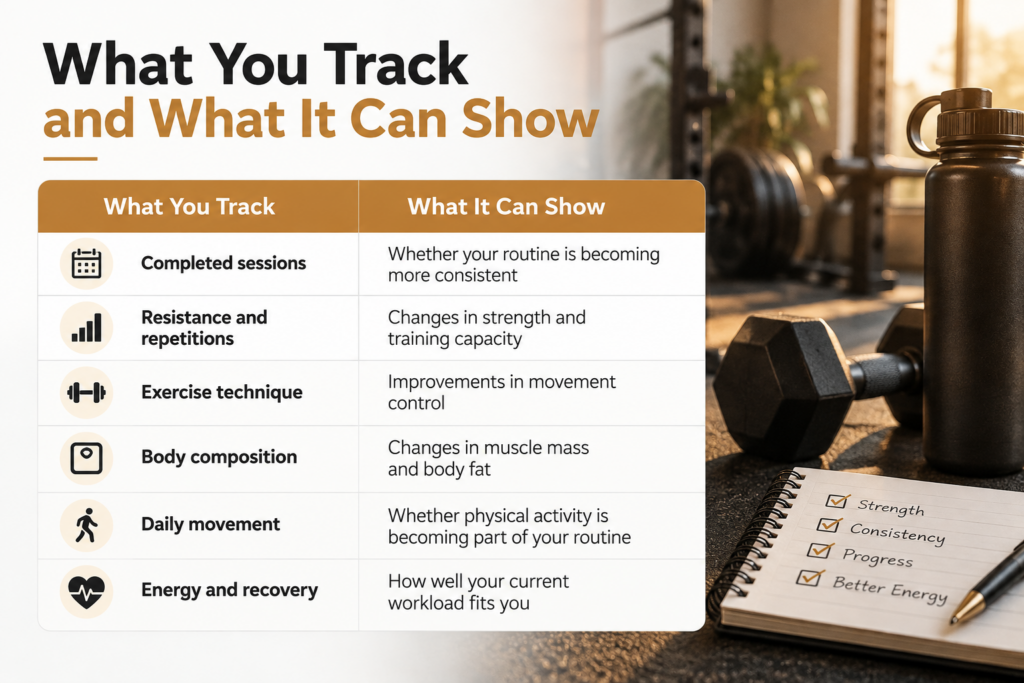
MK Fitness also offers body composition analysis, allowing clients to look beyond body weight and monitor measures such as muscle mass and body fat.
Seeing evidence of progress can make the process more concrete, especially during periods when visual changes are less obvious.
6. Accountability Becomes Practical, Not Punitive
Accountability is sometimes misunderstood as having someone make you feel guilty for missing a workout.
Useful accountability works differently.
A coach can notice patterns and help you solve them.
- If you repeatedly miss Friday evening sessions because work runs late, the solution may not be “try harder.” It may be moving the session.
- If you keep skipping independent workouts because they take too long, the solution may be simplifying them.
- If you dread one particular exercise, the coach can determine whether there is another appropriate variation.
That turns accountability into problem-solving.
The CDC includes scheduling activity, exercising with others, and building activity into a regular routine among its strategies for addressing common barriers such as lack of time or motivation.

Personalized accountability adds another layer: someone can help identify why your routine keeps breaking and make an appropriate adjustment.
7. A Missed Workout Does Not Have to Become a Missed Month
One of the most useful skills beginners can develop is learning how to restart quickly.
You will eventually miss a workout.
You may travel. Work may become unusually busy. You may have family commitments. Your schedule may change unexpectedly.
None of those situations automatically means your routine has failed.
The bigger problem occurs when one missed session turns into an all-or-nothing decision:
“I already missed this week, so I’ll start Monday again.”
Then Monday becomes next month.
Personalized coaching can help you plan for imperfect weeks instead of pretending they will never happen.
For example:
- Normal week: complete your planned training schedule.
- Busy week: keep your most important sessions and reduce optional activity.
- Disrupted week: do what reasonably fits your circumstances and return to your normal schedule when possible.
This approach makes consistency in fitness more flexible. You are measuring consistency across months, not expecting a flawless streak every week.
8. Your Training Can Stay Connected to Your Actual Goal
People rarely begin exercising simply because they want to “exercise.”
There is usually a reason behind it.
You might want to become stronger, lose body fat, have more energy, move more comfortably, feel more confident, or make everyday physical tasks easier.
Your training should reflect that reason.
Someone primarily interested in practical strength and mobility may benefit from a different emphasis than someone pursuing fat loss. A person focused on changing body composition may also need to consider training, nutrition, and progress measurements together rather than treating every workout as a calorie-burning session.
At MK Fitness, fat loss training combines structured exercise with nutrition support and progress tracking, while functional fitness focuses more specifically on movement, strength, stability, and mobility.
Personalization keeps the program connected to the outcome you actually care about. That makes it easier to understand why you are doing each part of your routine.
9. You Learn How to Become More Independent
Good coaching should not leave a beginner permanently confused about fitness.
Over time, you can start understanding:
- how to set up basic exercises;
- what controlled technique feels like;
- how much effort is appropriate;
- why certain exercises are included;
- how recovery affects training;
- how progress is measured; and
- when a workout needs to be adjusted.
That knowledge matters because long-term workout consistency cannot depend entirely on someone telling you what to do every minute.
Personalized coaching can provide more support at the beginning while helping you develop the skills and confidence needed to understand your own training better.
If you are still deciding whether you need that level of support, understanding how to start with a personal trainer can help you determine what to expect from the process.
What Does Consistency Actually Look Like for a Beginner?
Consistency does not mean exercising every day. It does not mean never missing a session. And it does not mean pushing through every workout regardless of how you feel.
A better definition is repeatedly returning to a realistic training routine over time.
For one beginner, that may initially mean two structured sessions each week. Another person may comfortably handle more. What matters is establishing a starting level that can be repeated and gradually developed.
If you are wondering how often beginners should work out, your current activity level, training experience, goals, recovery, and schedule should all influence the answer.
The broader health target for adults remains at least 150 minutes of moderate-intensity aerobic activity each week plus muscle-strengthening activity on two days. However, current guidance is clear that inactive people can start smaller and build toward those levels gradually.
That is why learning how to consistently work out is less about finding a perfect weekly number and more about finding a sustainable starting point.
Build a Routine You Can Keep at MK Fitness
If you have started exercising several times but struggled to make it stick, another generic workout plan may not solve the problem.
You may need a plan that accounts for your current fitness level, schedule, goals, and the obstacles that have made consistency difficult before.
At MK Fitness in Glendale, personalized coaching combines individualized workouts, functional movement, progress tracking, nutrition guidance, and accountability. Programs are designed around the individual rather than expecting every client to follow the same routine.
Beginners can also start with a free InBody measurement session to establish body-composition measurements that can be used alongside other progress markers.
The aim is not to create a routine you can follow only while motivation is high. It is to build one that still makes sense when fitness becomes part of ordinary life.
Book a free consultation with MK Fitness
Frequently Asked Questions
1. How Can a Beginner Stay Consistent With Working Out?
Start with a schedule you can realistically repeat, choose activities appropriate for your current ability, and gradually increase your workload. Scheduling workouts in advance and tracking completed activity can also help.
2. How Does Personalized Coaching Help With Workout Consistency?
Personalized coaching removes much of the guesswork involved in training. Your coach can create your schedule, select appropriate exercises, monitor technique, track progress, and adjust the program when your abilities or circumstances change.
3. How Many Days a Week Should a Beginner Exercise?
For most beginners, two to three well-planned workouts per week can be a practical starting point. The right frequency depends on your goals, recovery, schedule, and how demanding each session is.
4. Is It Okay to Miss a Workout?
Yes. One missed workout does not erase your previous progress. Rather than trying to compensate with an excessively difficult session, return to your planned routine as soon as practical.
5. Why Do I Keep Starting and Stopping My Workout Routine?
The problem may be the structure of your routine rather than a simple lack of motivation. Common barriers include lack of time, low energy, uncertainty about what to do, unrealistic schedules, and trying to progress too quickly. Identifying the specific barrier makes it easier to adjust the plan.
6. Can Personal Training Help if I Have Never Worked Out Before?
Yes. MK Fitness states that beginners can start at their current fitness level without previous gym experience. Training can begin with appropriate exercises and technique instruction, with the difficulty increased as strength and confidence develop.
7. How Long Does It Take to Build Workout Consistency?
There is no fixed number of days that applies to everyone. Instead of focusing on a deadline, concentrate on repeatedly completing a manageable schedule and making adjustments when necessary. Over time, training can become a regular part of your weekly routine.


