
Starting to work out is a good decision. Trying to do everything perfectly from day one is where things often go wrong.
Many beginner workout mistakes do not come from a lack of effort. They come from doing too much too soon, following advice meant for more experienced people, changing routines before they have time to work, or assuming a successful workout has to leave you completely exhausted.
The good news is that beginners do not need a complicated program to make progress. You need a starting point that fits your current ability, enough consistency to improve, and a way to gradually challenge yourself as you get stronger.
If you are learning how to start exercising as a beginner, here are the mistakes worth avoiding and what to do instead.
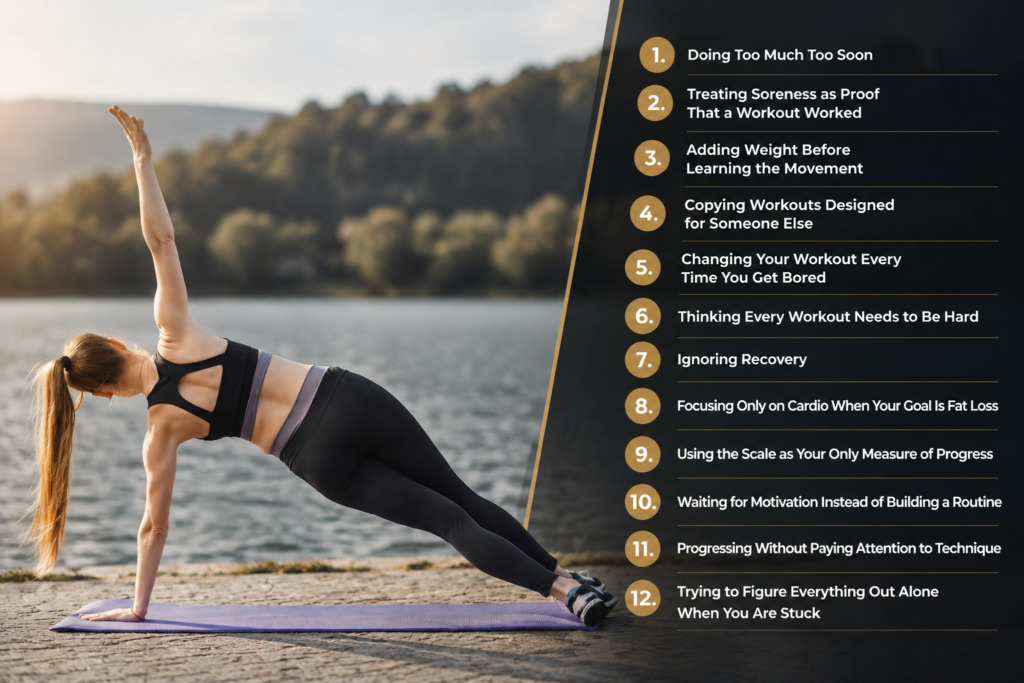
1. Doing Too Much Too Soon
One of the most common mistakes when starting to work out is trying to make up for lost time.
You feel motivated, so you train hard several days in a row, add extra cardio, dramatically increase your daily activity, and expect yourself to maintain the new routine indefinitely.
The problem is not enthusiasm. The problem is starting with a workload you are not prepared to repeat.
For someone who has been inactive, current physical activity guidance recommends starting with manageable amounts of exercise and gradually working toward higher activity levels. Small increases can be easier to maintain than attempting the full recommended activity level immediately.
A better approach is to ask:
- Can I realistically repeat this schedule next week?
- Am I recovering well between sessions?
- Is my technique staying controlled as I get tired?
- Am I increasing my workload gradually rather than all at once?
Your first few weeks are about building a foundation, not proving how hard you can train.
If you are unsure where that foundation should begin, our beginner fitness guide walks through the process of building a more realistic starting routine.
2. Treating Soreness as Proof That a Workout Worked
A workout does not have to make it difficult to walk the next morning to be effective.
Muscle soreness can happen when you introduce unfamiliar exercises, increase training volume, or return to exercise after time away. But soreness by itself does not tell you whether your program is producing meaningful progress.
This is an important distinction for beginners because constantly chasing soreness can encourage you to change exercises, add unnecessary volume, or train harder than you are ready for.
Instead, look for progress such as
- Better exercise technique
- More control through each movement
- Gradually using more resistance
- Completing additional repetitions with good form
- Improved stamina
- Better consistency
- Greater confidence during workouts
Progress often looks less dramatic than an exhausting workout, but it is much more useful.
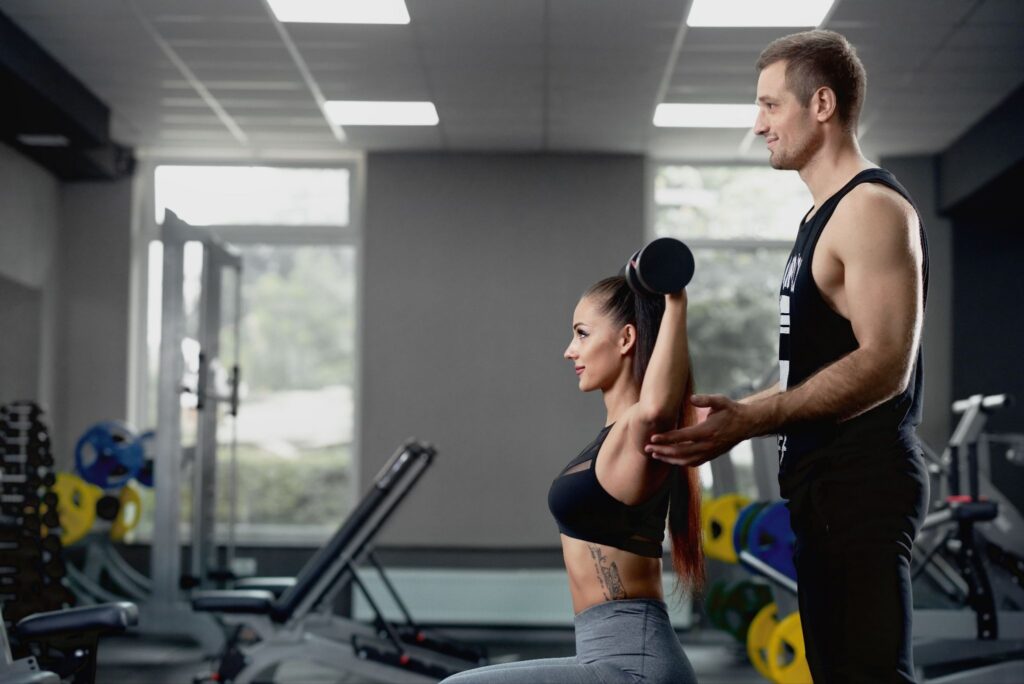
3. Adding Weight Before Learning the Movement
Another frequent beginner gym mistake is focusing on how much weight you can lift before learning how to perform the exercise well.
Resistance matters, but so does movement quality.
Before making an exercise heavier, you should understand the basic movement, maintain control, and be able to repeat the technique consistently. That may mean learning how to squat, hinge, push, pull, carry, or brace before worrying about numbers.
This is where functional training can be especially useful. The focus is not simply on moving heavier weights. It is developing strength, stability, mobility, control, and movement that supports both your workouts and everyday activity.
For beginners, a lighter exercise performed well is usually more useful than a heavier version performed without control.
4. Copying Workouts Designed for Someone Else
Social media makes it easy to find workouts. It does not tell you whether those workouts are appropriate for you.
An exercise routine created for someone with several years of training experience may not make sense for someone completing their first month in the gym.
Even two beginners with the same goal may need different programs.
One person may need more work on balance and movement control. Another may already have a strong athletic background but need help establishing consistency. Someone else may have a demanding schedule that makes a five-day routine unrealistic.
Your program should reflect:
- Your current fitness level
- Your goals
- Your exercise experience
- Your schedule
- Your recovery
- Your preferences
- How you respond to training
That is one reason personal training can be valuable when generic programs leave you unsure about what applies to you. A trainer can adjust the exercises, resistance, volume, and progression based on your actual starting point.
5. Changing Your Workout Every Time You Get Bored
Variety can make exercise enjoyable. Constantly changing everything can make progress difficult to measure.
If you perform completely different exercises every workout, you may never spend enough time practicing a movement to become stronger or more efficient at it.
Beginners often benefit from repeating foundational movements over time while adjusting variables such as resistance, repetitions, sets, tempo, or exercise difficulty.
Current ACSM resistance-training guidance emphasizes consistency, training the major muscle groups, and gradually progressing over time rather than relying on complicated techniques.
Your workouts do not have to be identical forever. They simply need enough continuity for you to learn what you are doing and see whether it is working.
6. Thinking Every Workout Needs to Be Hard
More difficult does not automatically mean more effective.
A well-designed program can include challenging sessions, but your training also has to leave enough room for recovery and continued performance.
If every workout is an all-out effort, you may notice your technique declining, motivation dropping, or workouts becoming increasingly difficult to complete consistently.
Beginners especially need time to adapt.
7. Ignoring Recovery
The workout is the training stimulus. Progress also depends on what happens between workouts.
Sleep, nutrition, stress, and the amount of training you are doing all affect how well you recover.
That does not mean beginners need an elaborate recovery routine. Often, the basics matter most:
- Give repeatedly trained muscles appropriate recovery time.
- Eat in a way that supports your training and goals.
- Stay hydrated.
- Get adequate sleep.
- Avoid suddenly increasing several parts of your routine at once.
- Adjust when your body is not recovering well.
If you have a chronic health condition or concerns about beginning more vigorous activity, it is appropriate to discuss the type and amount of exercise with a healthcare professional.

8. Focusing Only on Cardio When Your Goal Is Fat Loss
Another common beginner fitness mistake is assuming fat loss requires doing as much cardio as possible.
Cardiovascular activity can absolutely be part of a balanced fitness program, but it is not the only piece.
A more complete approach can combine resistance training, regular activity, nutrition habits, recovery, and consistency. Resistance training also helps you build and maintain strength while you work toward broader body-composition goals.
MK Fitness’s approach to fat loss training combines structured workouts with nutrition guidance and accountability, rather than treating fat loss as a matter of simply doing harder or longer workouts.
The goal is not to see how many calories you can burn in one session. It is to create habits you can continue long enough to produce meaningful change.
9. Using the Scale as Your Only Measure of Progress
You train for several weeks, step on the scale, and see less change than expected.
It can be frustrating, especially when body weight is the only number you are watching.
But your fitness can improve in ways a scale cannot show.
You may be:
- Getting stronger
- Moving with better control
- Improving your endurance
- Becoming more consistent
- Changing your body composition
- Finding everyday activities easier
- Becoming more confident with exercise
For clients who want additional information about physical changes, body composition analysis can provide insight into factors such as body fat and muscle mass instead of relying solely on total body weight.
Tracking the right indicators makes it easier to recognize progress that might otherwise be missed.

10. Waiting for Motivation Instead of Building a Routine
Motivation is useful for starting. It is unreliable for maintaining a program.
You will have weeks when training feels exciting and weeks when work, family responsibilities, stress, or fatigue make it less appealing.
That is normal.
Learning how to build a consistent workout routine means reducing the number of decisions you have to make.
For example:
- Choose realistic training days in advance.
- Put sessions on your calendar.
- Have a shorter backup workout for busy weeks.
- Track completed sessions.
- Keep your routine simple enough to repeat.
- Return to your schedule after a missed workout instead of treating it as failure.
The goal is not perfect attendance. It is making your routine resilient enough to survive normal life.
11. Progressing Without Paying Attention to Technique
Progression is an important part of training, but adding more weight is only one way to progress.
You may also improve by performing a movement with better control, completing more repetitions, increasing your range of motion where appropriate, improving stability, or handling the same workout more comfortably.
Do not rush progression simply because you think you should be lifting more by a certain date.
Your body does not follow someone else’s timeline.
For beginners, progress should come from what you can perform safely and consistently today, followed by an appropriate next challenge.
12. Trying to Figure Everything Out Alone When You Are Stuck
There is nothing wrong with training independently. But if you repeatedly find yourself asking:
- Am I doing this exercise correctly?
- How much weight should I use?
- How often should beginners work out?
- When should I increase the difficulty?
- Why am I not making progress with my workouts?
- Which exercises actually fit my goals?
Then more information may not be what you need. You may need better direction.
A coach can observe how you move, identify where your program needs adjustment, and give you a clear progression instead of leaving you to troubleshoot every workout yourself.
If you have never worked with a trainer before, reading about your first personal training session can help you understand what the process looks like before you begin.
You can also learn more about how to start with a personal trainer if you are deciding whether coaching makes sense for your goals.

So, How Often Should Beginners Work Out?
There is no single weekly schedule that is right for every beginner.
Your training frequency should reflect your current fitness level, goals, workout intensity, other physical activity, schedule, and ability to recover.
For general health, U.S. guidelines recommend that adults work toward at least 150 minutes of moderate-intensity aerobic activity per week, or the vigorous-intensity equivalent, along with muscle-strengthening activity on at least two days. Those totals can be spread throughout the week, and people who are currently inactive can build toward them gradually.
That does not mean every beginner needs to jump immediately into a packed weekly schedule.
A routine you can perform consistently and gradually progress is more useful than an ambitious schedule you abandon after two weeks.
What Does Good Beginner Progress Actually Look Like?
If you are new to exercise, progress does not have to mean dramatic physical changes every week.
Early progress may look like:
- Week one: You learn where to place your feet during a squat.
- A few sessions later: The movement feels more natural and controlled.
- Later: You perform additional repetitions or use more resistance without losing that control.
The same principle applies to your broader routine. At first, success may simply mean showing up consistently. Later, you can increase the challenge as your fitness develops.
That is how to make progress as a beginner at the gym: learn, repeat, recover, adjust, and gradually do more when you are ready.
Start With a Plan You Can Build On
The biggest beginner workout mistake may be expecting yourself to train like someone who is no longer a beginner.
You do not need the most intense program, the most exercises, or the fastest transformation.
You need a plan appropriate for where you are now and enough consistency to build from it.
At MK Fitness, training is personalized around your goals, abilities, schedule, and lifestyle, with coaching that can include strength and mobility work, nutrition guidance, progress tracking, and accountability.
If you are in or near Montrose and want more direction than trial-and-error workouts can provide, explore personal training in Montrose to see how one-on-one coaching can help you create a clearer path forward.
You can also explore personal training in Glendale and MK Fitness’s broader personalized training options.
Ready to stop guessing about what your workouts should look like? Schedule a free consultation and start with a training plan built around you.
Frequently Asked Questions
1. What are the most common beginner workout mistakes?
Some of the most common beginner workout mistakes include doing too much too soon, using more weight before learning proper technique, copying advanced workouts, changing exercises constantly, ignoring recovery, and relying on motivation instead of developing a repeatable routine.
2. What mistakes should beginners avoid at the gym?
Beginners should avoid comparing their training to more experienced gym members, progressing faster than their technique allows, and assuming every workout needs to be extremely difficult. Focus on learning foundational movements, training consistently, and increasing the challenge gradually.
3. Why am I not making progress with my workouts?
There can be many reasons. Your training may lack consistency, clear progression, adequate recovery, appropriate exercise selection, or a way to measure progress. Your goals, nutrition, sleep, and overall activity can also influence results. If you have been training consistently without knowing what to adjust, personalized coaching can help identify where your program needs more structure.
4. How often should beginners work out?
There is no single schedule that works for everyone. Your ideal frequency depends on your current activity level, goals, recovery, schedule, and workout intensity. Inactive beginners can start with manageable amounts of exercise and gradually increase their activity rather than trying to do too much immediately.
5. How can beginners avoid injury when starting to work out?
Start at an appropriate level, learn exercise technique before significantly increasing resistance or complexity, progress gradually, and pay attention to unusual pain or concerning symptoms. If you have a health condition or other concerns about starting exercise, speak with an appropriate healthcare professional about what is suitable for you.
6. How can I build a consistent workout routine?
Choose a realistic weekly schedule, plan your sessions in advance, keep your program simple enough to repeat, and have a reduced version available for busy weeks. If you miss a workout, return to your normal routine rather than trying to compensate by doing too much later.
7. How do I know when to increase the difficulty of an exercise?
Increase the challenge when you can perform the current version consistently with good technique and control. Progress may involve additional resistance, repetitions, sets, or a more challenging exercise variation. You do not need to increase everything at once.
8. Do beginners need a personal trainer?
Not every beginner needs a personal trainer, but coaching can be helpful if you are unsure where to start, want feedback on technique, struggle to stay consistent, or have been exercising without seeing the progress you expected. A trainer can create a program based on your starting point and adjust it as your abilities improve.


